Yes Meditation to Embrace a Busy Mind
by Jivana Heyman
The goal of this guided practice is to find a different relationship with your mind that doesn’t deny its active nature; rather, this is a practice designed to embrace the busy mind.
Most of the time, our minds are constantly changing as our mood shifts or as we get some bad news or good news. It’s like living on a roller coaster as someone gives us a compliment, then we read news about chaos in the world or we have a disagreement with a friend.
Yoga asks us how we can exit the ride altogether and stand back watching it go up and down from a safe distance. In the Gita, Krishna explains to Arjuna that meditation is the key to avoiding the constant ups and downs of life.
“When meditation is mastered, the mind is unwavering like the flame of a lamp in a windless place. In the still mind, in the depths of meditation, the Self reveals itself. Beholding the Self by means of the Self, an aspirant knows the joy and peace of complete fulfillment. Having attained that abiding joy beyond the senses, revealed in the stilled mind, they never swerve from the eternal truth. They desire nothing else and cannot be shaken by the heaviest burden of sorrow [6.19-22].”
It’s worth noting that we all have a negativity bias, an emphasis on the bad or painful parts of life. Psychologists believe that our negativity bias is an evolutionary trait that helped us survive by making us more aware of danger. But these days, it tends to just drag us down, since we now have access to so much negative information and news 24/7. It’s so prevalent that negativity bias is often used in advertising to feed our fears and feelings of insecurity.
As you begin to work with your mind in meditation, it’s worth noting if your mind has a tendency to focus on the negative.
When you sit with your own mind in meditation, it may obsess on your problems. Or it may simply focus on the feeling that you’re not good at meditation because your mind is busy. Either way, you may find that your entire meditation is spent in a negative spiral.
It’s no wonder that people don’t think they can meditate! These early stages can be upsetting and even painful.
What if you changed the way you approached your mind? To counteract the mind’s negativity, you could start by acknowledging that the mind is busy and that it likes to think. Rather than unsuccessfully attempting to stop the thoughts, try embracing them.
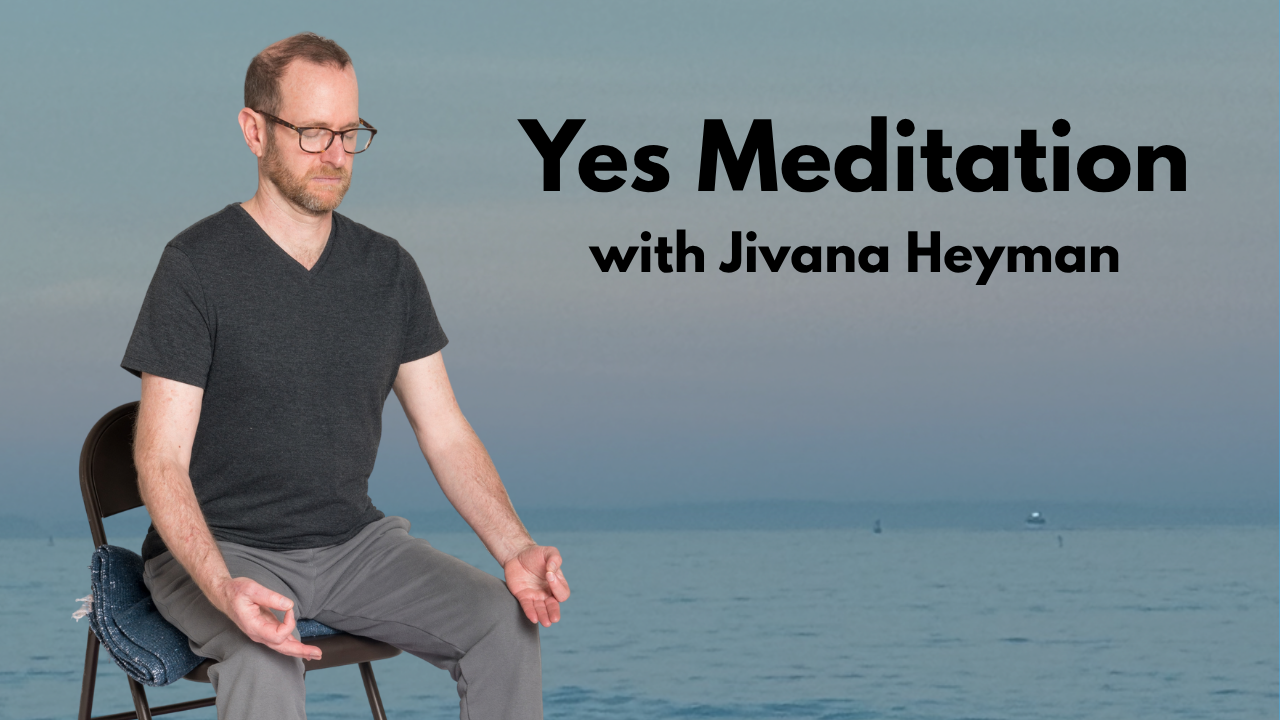
I like to practice the “Yes” Meditation above, in which I silently say the word “yes” every time my mind has a thought. A thought is any vritti, or movement of the mind. This includes words you’re saying to yourself, images, memories, feelings, or any sensory awareness, such as hearing a sound or seeing a light.
I hope you'll try it and let me know how it goes!
Want to explore how to build an accessible meditation practice?
My 4-week online course, Yoga Meditation, starts on November 19 with a FREE Session!